


The project on applying nuclear power to rice production is carried out by the Center for Human Potential.
With a strange and groundbreaking production method, rice "electric multiplier" has been sold on the market at high prices and is strongly consumed, because according to the authors, it has many outstanding advantages. However, there are still some opposing opinions from some scientists about this production method.
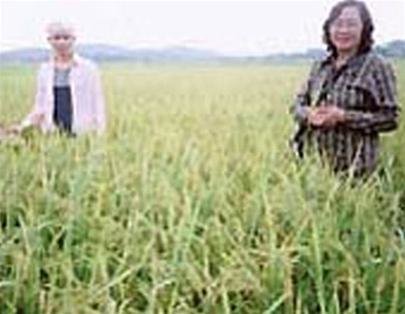
Associate Professor-Dr. Doan Thi Bang Tam (right) at the rice field at the power station
With a strange and groundbreaking production method, rice "electric multiplier" has been sold on the market at high prices and is strongly consumed, because according to the authors, it has many outstanding advantages. However, there are still some opposing opinions from some scientists about this production method.
"Research on bioenergy impacts on rice plants" is a grassroots scientific topic by Associate Professor-Dr. Doan Thi Bang Tam and Professor-Dr. Le Xuan Tu (Human Potential Research Center under the Vietnam Union of Science and Technology Associations). The authors invited a number of scientists affiliated with Duc Tien Science Production and Service Enterprise.
For the first time this type of rice was introduced at the North Central Technology and Equipment Market (held in Nghe An) in mid-May. Here, rice was sold for up to 10,000 VND/kg but still "on fire" row.
Monitor rice cultivation methods "electric multiplier", people only see electricity workers coming home every week "look" rice fields a few times, each time "look" from 30 seconds to 1 minute to "energy transmission" for rice without using fertilizers, pesticides, or chemical herbicides. At first (2003 - 2004), the project only studied the energy impact on two rice varieties, Bac Thom 7 and Khang Dan 18, but now scientists have confirmed that any rice variety can be grown using this method.
Associate Professor Dr. Doan Thi Bang Tam said: "The wish of scientists is to use the impact of nuclear power to improve the environment, not only to produce food but also clean food. For that reason, we will build a village to develop in all aspects in Dan Tham village, My Hung commune, Thanh Oai district - Ha Tay. Here, not only rice will be grown with electric power, but will also grow synchronously, from geese and pigs to shrimp and fish...".
Currently, she and other rice breeders are conducting experiments from North to South, both to test the impact of nuclear power on rice varieties in different regions and so that all rice breeders in the regions can participate in rice farming. According to her, if allowed by the Government, electric rice can be grown on a large scale, provided that three factors are well prepared: land, people, seeds, and must be cultivated in three consecutive seasons.
From pilot rice seasons in Bac Ninh, Ha Tay, Bac Giang, Tra Vinh... the authors of the project sent soil samples after 3 rice seasons to the Institute of Soil Agrochemistry. According to them, the analysis results show that soil fertility and absorption capacity indicators have not decreased. The next rice crop yield is higher than the previous crop. From the third rice crop onwards, the yield is more stable while the soil quality is still not poor.
Doctor of Science Dinh Luyen commented: "Electric rice has high whiteness, good gloss, delicious cooked rice quality, and moderate stickiness". Besides, there are some notable characteristics such as rice being left to rot for a long time, rice being less susceptible to rat damage, brighter color due to not being infected by bugs, weighing 1,000 grains of rice with electric rice and found it heavier than regular rice, so the ratio of rice with electric rice after milling is higher than regular rice.
* Opinions of scientists"Based on the law of conservation of matter, if rice is grown using this type of bioelectricity, where will the rice plant get its nutrition from? According to some research documents, to produce 5 tons of rice seeds, it is necessary to fertilize 65kg of pure N/ha, 20kg of B205, 75kg of K20 and many other substances... So if only "look" Where does rice get nutrients to compensate? I don't understand this mechanism yet. From a biological standpoint, we should also review. This may be true if the field already has excess nutrients from previous crops and the soil is still good. But one case is fine, what if we continue to do many cases in a row like this? Water, air, and nutrients in the soil are not eternal", Associate Professor Dr. Huynh Thanh Hung - Head of Soil Science and Fertilizer Department, Vice Principal of Ho Chi Minh City University of Agriculture and Forestry - questioned.
"In my opinion, growing rice with nuclear power is not feasible, because every crop needs nutrition and light. The use of electricity to release electricity into rice plants and the plants to absorb them to create nutrients for high yields, if it happens, is only done by a few people. Not everyone has the ability to discharge electricity like that and the rice fields are vast, how many people can discharge electricity?
Currently, we are also implementing trial planting of safe rice on an area of 50 hectares in Go Cong Tay, Tien Giang province. It is said that rice is safe, but it only does not use pesticides, the rest still has to use organic fertilizer and a little chemical fertilizer. Besides, we also have to fully apply technical measures such as sowing thinly in rows, choosing varieties carefully, and applying balanced fertilizer so the rice fields have good resistance, high productivity of 6-7 tons/ha and have reached the 3rd crop." - Dr. Pham Si Tan, Deputy Director of the Mekong Delta Rice Institute, spoke.
"Our institute has also been experimenting with this method for more than a month and a half now, but we still cannot conclude anything. However, if the method of growing rice with nuclear power is successful, it will open up a new direction for farmers. Because with this method, farmers do not need to fertilize and spray chemicals, thus saving costs, rice quality is close to nature and significantly reduces environmental pollution, affecting the health of farmers and the community.
With this method we also have a person transmitting electricity. However, this is still an issue that needs to be seriously researched and evaluated by scientists before being introduced" - Master Nguyen Ngoc De, Institute for Research and Development of Farming Systems, Can Tho University, commented.