


So our Love for Humanity Group continued our journey to the central highlands of the country. Perhaps the names Dak Lak and Lam Dong are not strange to all of us because those places have been associated with many memorable events in the nation's history. Like many previous trips, this time we came to these places to harmonize spirituality, resolve conflicts and hatred, and liberate souls who have not yet been transcended.
Day one in Dak Lak
Sac Tu Khai Doan Pagoda, the largest pagoda in Buon Ma Thuot and Dak Lak province, was the first destination of our group. The name Khai Doan is a combination of the names of King Khai Dinh and his wife, Queen Mother Doan Huy (Ms. Tu Cung) - who built the pagoda in 1951. This is the last pagoda in Vietnam to be awarded the fourth title of the feudal regime. It can be said that Sac Tu Khai Doan Pagoda is the cradle of Central Highlands Buddhism, because from here hundreds of pagodas in Dak Lak province were formed.
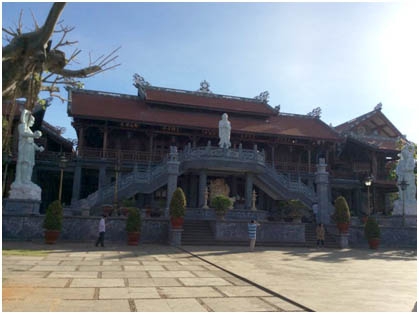
Sac Tu Khai Doan Pagoda, Buon Ma Thuot, Dak Lak
Leaving Khai Doan, we came to Buon Ma Thuot Prison House. The French built this place in the period 1930 - 1931 to detain Vietnamese patriots who were severely sentenced in the Central provinces, especially those who were leaders in the Nghe Tinh Soviet movement. Today this place is a destination to visit and learn history for many generations of students. Our group met many students who followed their teachers to learn about the history of this place.
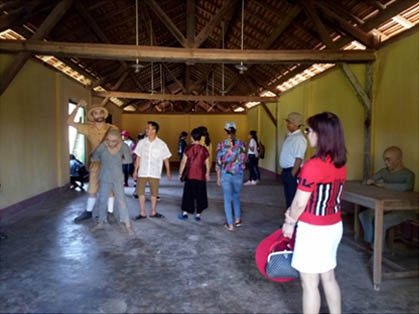
Banished House Buon Ma Thuot, Dak Lak
Continuing our journey, we came to Bao Dai Palace. This house was previously the residence of Sabatier - Ambassador of the French government in the Central Highlands. Afterwards, the house was rebuilt for King Bao Dai to stay while hunting in Dak Lak, from then on this place had a new name, Bao Dai Villa. In 1945, the oath-taking ceremony of brotherhood of the ethnic groups in the Central Highlands region took place here. After the fall of former Emperor Bao Dai's government, the house was used as a motel for generals and generals of the Republic of Vietnam government whenever on official duty in Dak Lak. Today Bao Dai Palace has become the Museum of Vietnamese Ethnic Groups in Dak Lak. Here are displayed many valuable cultural artifacts of more than 44 ethnic groups living in Dak Lak. The space of gong culture and the cultural identity of the Central Highlands people are clearly expressed in this place.
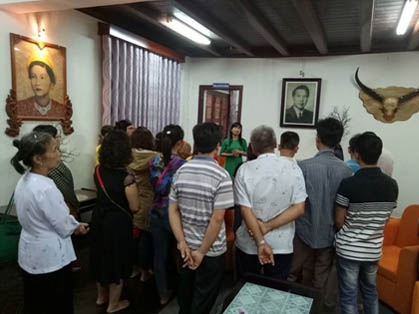
Bao Dai Palace, Dak Lak
Coming to Dak Lak, we cannot miss Yang Prong Cham Tower, a place imbued with the culture of the Cham people in the Central Highlands. The tower was built around the 13th century and was discovered by a French explorer. The tower is 9m high, has a square base and each side is 5m long, and has a door opening to the East. Yang Prong means the tower worshiping the Big God, the god who governs the harvest according to the ancient Cham people.
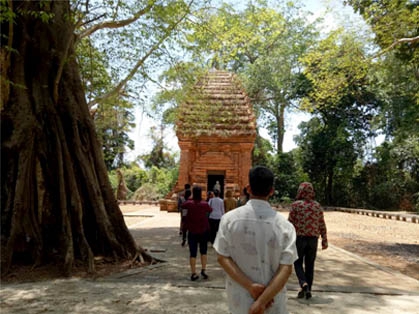
Yang Prong Cham Tower, Dak Lak
At the end of the first day of the trip, we arrived at Lak Lake. Lak Lake is the largest natural freshwater lake in Dak Lak province and the second largest in Vietnam after Ba Be Lake. The lake is over 5 km² wide, connected to the Krong Ana river. The lake's surface is always green and surrounded by high mountains and vast primeval forests with rich flora and fauna. According to legend, Lak Lake was created by hero Lak Lieng of the M'Shallow. The lake is located next to many historical relics such as Buon Jun, a famous village of the M'Farm, Bao Dai Palace and Long House of the M people'Shallow.
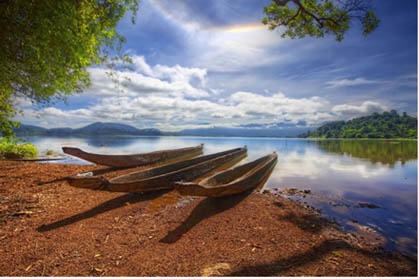
Lak Lake, Dak Lak
Second day in Lam DongLeaving Dak Lak we headed to Lam Dong, where Da Lat city is known as the land of Peach and Mimosa flowers. We started a new day at Linh Phuoc Pagoda, also known as Ve Chai Pagoda because in the temple yard there is a 49 m long dragon made of 12,000 bottles and jars. Linh Phuoc Pagoda is a unique mosaic architectural work of Da Lat city. Construction of the pagoda began in 1949 and was completed in 1950.
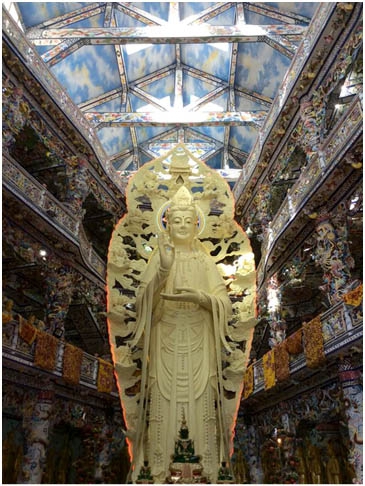
Linh Phuoc Pagoda (Ve Chai Pagoda), Da Lat, Lam Dong
Saying goodbye to Ve Chai Pagoda, we headed straight to Thien Vuong Co Sat Pagoda, also known as Phat Tram Pagoda or Chinese Pagoda, a pagoda located on Dragon Hill, 5 km northeast of Da Lat city center. The pagoda was built in 1958 by Venerable Tho Da of the Chaozhou Assembly Hall, consisting of 3 wooden houses with corrugated iron roofs. In 1989, Mr. Le Van Canh took charge of the restoration and rebuilding. During the restoration, the middle house was dismantled to create open space for the remaining two buildings. The pagoda is imbued with the values and architectural style of Chinese pagodas and assembly halls. The monks, nuns and Buddhists in the temple all speak Cantonese and Chinese. This is one of the attractions that attracts many tourists when they come to Lam Dong and Da Lat city.
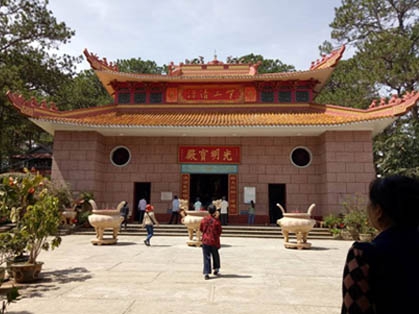
Thien Vuong Co Sat Pagoda, Da Lat, Lam Dong
For us, harmonizing religions is extremely necessary because essentially all religions are the same in that they teach people to be good. So, on this trip, along with visiting Buddhist temples, we also visited Catholic cathedrals. Dalat Cathedral, also known as St. Nicholas Bari Cathedral, is also known as Chicken Church because on the top of the bell tower there is a large chicken image. This church was officially started on July 19, 1931 by Bishop Colomban Dreyer and the construction took 11 years. This is the largest church in Da Lat and one of the most typical and ancient architectural works of this city left by the French.
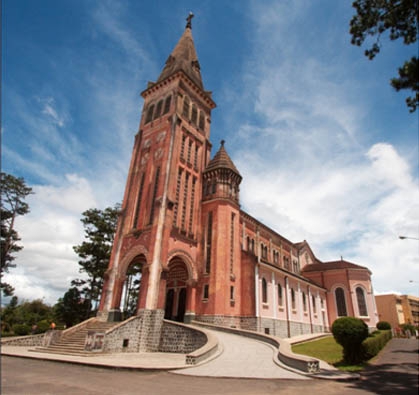
Dalat Cathedral, Lam Dong
Leaving Da Lat city, we came to Langbiang mountain, 12 km from Da Lat city in Lac Duong district. Langbiang is likened to "roof" of Da Lat, and is an attractive tourist attraction of this city. According to legend of the K'Ho people, Langbiang - is the compound name of K'lang and H'biang. K'lang (Lat people, a branch of the K'Ho ethnic group) and H'biang (Chil people, another branch of the K'Ho ethnic group) met by chance while going to the forest to pick fruit. H'Biang was in trouble and K'lang bravely saved her from a pack of ferocious wolves. Then they fell in love with each other, but their love was hindered by the hatred between these two ethnic groups. Overcoming strict customs and rituals, the two were still determined to become husband and wife, and they moved to a place on the top of the mountain to live. When H'Biang was sick, K'lang tried every way to cure him but could not cure him. He had to return to report to the village to find a way to save her. Miss H's tribe'biang hated him very much and they used a poisoned arrow to kill him, but H'biang blocked the arrow for him. Extremely sad, K'lang cried a lot, his tears flowed into a large stream, today called Da Nhim (weeping stream). After the death of the two people, Father H'biang was very regretful and united the tribes into a people called K'Ho. From then on, couples in the village easily came together.
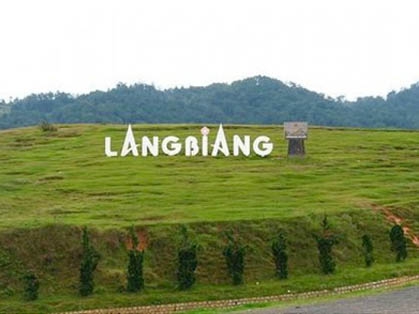
Langbiang, Da Lat, Lam Dong
At the end of the journey, we came to the Redemptorist Church, Tung Lam parish. Tung Lam is located north of Da Lat city and at kilometer 7 on the road to Suoi Vang. Tung Lam Da Lat Redeemer Parish was established nearly 60 years ago and is in charge of the Redemptorist Fathers. We visited Tung Lam parish right on Easter with many moods and emotions, and hope that the parishioners here will always be happy and peaceful.
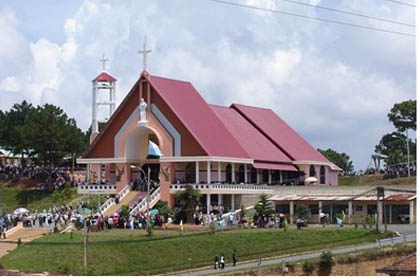
Tung Lam Redeemer Parish, Da Lat
Dak Lak - Lam Dong is a long journey, especially for the elderly members of our group. Enlightenment and love are the driving forces that help us overcome difficulties and physical fatigue to reach the above places. We always hope that enlightenment and love will always be shared and widely spread in the lands we have visited and will visit in the future.